




Most people who know about the sacral chakra think they know what it governs. They are partly right — and missing what matters most.
The svadhisthana chakra — also known as the sacral chakra — is the second energy center in the classical yogic system. Located two to three finger-widths below the navel, it governs the water element, the principle of cohesion, and the body's capacity for joy, genuine connection, and felt aliveness. Its endocrine correspondence, in Dr. Vasant Lad's teaching, is the adrenal glands.
Svadhisthana chakra is almost universally introduced through the lens of sexuality and sensory pleasure. This is not wrong, exactly — but it is a narrow entry point into a center whose governing principle is something far older and more fundamental than desire. In the classical yogic and Ayurvedic framework, and particularly in the teaching of Dr. Vasant Lad, the sacral chakra governs the felt sense of joy and juiciness in the experience of being alive. That joy is physical, yes. But it is equally emotional — the warmth of genuine love, the opening of compassion, the quiet aliveness of true connection with another human being.
When svadhisthana is healthy, life feels inhabited rather than simply managed. When it is depleted or blocked, something more essential than pleasure goes missing — a quality of inner cohesion, of belonging to one's own experience, that no external stimulation can replace.
Understanding sacral chakra svadhisthana, then, requires setting aside the simplified version and returning to the classical one. What this center actually governs, why the adrenals are its endocrine correspondence in Dr. Lad's framework, how to recognize imbalance, and how to restore it — these are questions worth sitting with carefully.
Svadhisthana Chakra Meaning: More Than Pleasure
Svadhisthana means 'one's own dwelling place' — the seat of the self within embodied experience. The swadhisthana chakra meaning points to the organizing principle of this center, which is not desire but flow: the capacity to inhabit lived experience with full, fluid presence.
The name itself is the most honest place to begin. Svadhisthana means 'one's own dwelling place' — the seat of the self within embodied experience. It is the energetic center through which consciousness learns to inhabit a living, fluid body, and through which that body learns to move through experience without being overwhelmed by it.
The organizing principle here is not sensation. It is flow.
In the teaching of Dr. Vasant Lad, svadhisthana governs something he describes as the juiciness of experience — a quality that includes physical pleasure but extends into every dimension of felt aliveness. The warmth that arises in a moment of genuine connection. The deep satisfaction of work that aligns with one's nature. The physical ease of a body that is well nourished and unhurried. These are all expressions of the sacral chakra functioning well. They share a common quality: they arise naturally, without effort or performance, when the conditions are right.
This distinction matters because it changes how we understand imbalance. A person who has lost their sense of joy, their capacity for genuine connection, their felt pleasure in ordinary experience — this is not primarily a psychological problem. In the Ayurvedic framework, it is a constitutional signal that the water element and its governing center have been disturbed. The path back is not motivational. It is restorative.
The Water Element and the Principle of Cohesion
The element governing svadhisthana chakra is ap — water — understood in the classical Vedic framework not merely as a fluid but as the principle of cohesion itself. Water is what holds things together, what allows movement without fragmentation, what creates continuity across change. A river can move continuously, absorb what it encounters, and remain itself. This is the quality the sacral chakra is meant to sustain in a human life.
This cohesive quality operates on three simultaneous levels. The first is cohesion within the self — a stable inner identity that can hold steady as emotions move through it without being destabilized by them. The second is cohesion with purpose — what the tradition calls santosha, a deep contentment that is not a mood but an orientation, a quiet sense of alignment with one's own nature and direction. The third is cohesion with other beings — the warmth, belonging, and genuine relational presence that makes community possible rather than merely transactional.
When the water element is balanced in svadhisthana, these three operate together as one coherent experience of being alive. When the water element is disturbed — through chronic stress, emotional suppression, poor nourishment, or a life lived out of rhythm with natural cycles — one or all begin to fragment. Because water is what holds things together, this fragmentation is felt as something more pervasive than a specific symptom. It is felt as a general dryness, a loss of the juice of living.
Dr. Lad’s Teaching: The Swadhisthana Chakra and the Adrenal Glands
In Dr. Vasant Lad's framework, the svadhisthana chakra corresponds to the adrenal glands — not the reproductive glands, which he associates with muladhara. This distinction reframes the clinical picture of sacral chakra imbalance: chronic adrenal depletion produces exactly the loss of joy, cohesion, and felt connection that classical yoga attributes to svadhisthana disruption.
One of the most clinically significant distinctions in Dr. Lad's chakra framework concerns endocrine correspondence. Where many traditions associate the sacral chakra with the reproductive glands, Dr. Lad places the reproductive glands at muladhara. Svadhisthana, in his teaching, corresponds to the adrenal glands.
This is not a minor technical difference. It reframes the entire clinical picture of sacral chakra imbalance and points toward a very different path of restoration.
The adrenal glands govern not only the stress response but the organism's capacity for what might be called gusto — the felt vitality and readiness that makes genuine engagement with life possible. They are the physiological foundation of ease and aliveness simultaneously. When adrenal function is chronically taxed, the nervous system loses its capacity to settle into parasympathetic rest, and with it, the conditions for joy, connection, and inner cohesion disappear — not as a mood, but as a physiological possibility.
Modern physiology supports this with striking clarity. Chronic HPA axis dysregulation — the sustained activation of the stress response — produces precisely the constellation that classical yoga describes as svadhisthana depletion: hormonal irregularity, emotional reactivity, loss of pleasure in ordinary experience, diminished capacity for genuine connection, and a persistent sense of flatness that no amount of stimulation resolves. What the tradition named as a disturbance in the water element, contemporary medicine is increasingly recognizing as the downstream effects of adrenal exhaustion on the endocrine and nervous systems.
The two frameworks are not in conflict. They are describing the same phenomenon from different vantage points — and together they make the path of restoration more legible.
Classical Correspondences of the Sacral Chakra
In the classical framework, each correspondence associated with svadhisthana is not decorative. It is a channel — a frequency through which the water element's natural intelligence can be invoked and restored. Understanding the correspondences of swadhisthana chakra yoga means understanding them as medicine, each one a doorway back into cohesion.
Element: ap — water | Color: orange | Bija mantra: VAM | Sense organ: tongue (taste) | Planet: Moon | Deities: Vishnu and Rakini | Sacral chakra location: two to three finger-widths below the navel
Sacral Chakra Colors: Orange and the Glow of Inner Vitality
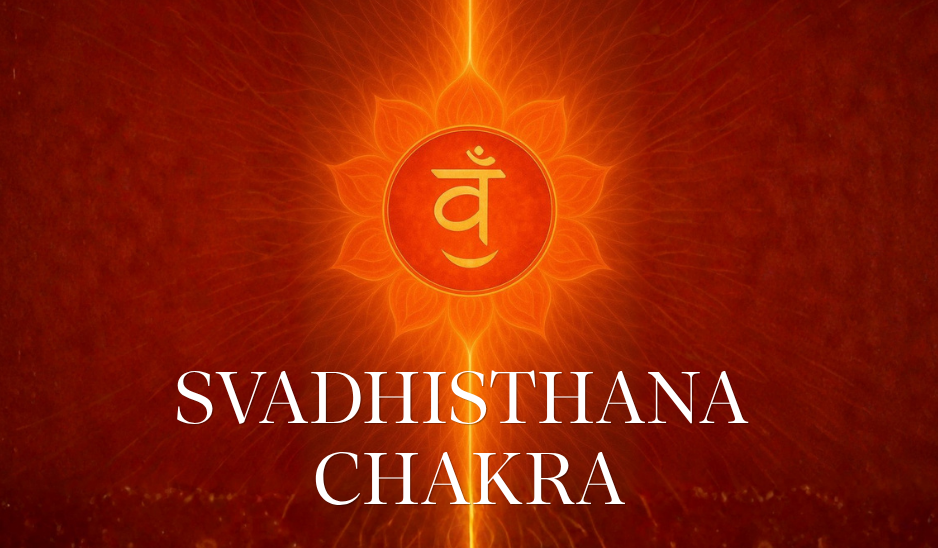
The primary sacral chakra color is orange — not the aggressive brightness of fire but the warm, sustained glow of a life being genuinely inhabited. In chromotherapy and classical symbolism alike, orange corresponds to warmth, creativity, and the vitality that sustains living over time. Working with this color — in visualization, in the environment, in contemplative practice — creates a vibrational resonance with the center's natural frequency. The sacral chakra colors extend into the golden amber of candlelight and the deep warmth of autumn earth, each shade an invitation back into embodied aliveness. Orange brings the frequency of nourished joy without the intensity of red or the dispersal of yellow.
Bija Mantra: VAM and the Sacral Chakra Symbol
The seed sound of the water element is VAM — chanted as a single sustained syllable that vibrates in the sacral region and creates direct resonance with this center's governing principle. In Ayurvedic sound medicine, bija mantras carry the vibrational intelligence of their corresponding elements. Chanting VAM consistently, particularly in the morning or during meditation, is understood to restore the water element's natural flow and support adrenal regulation through vagal activation. Sustained vocalization activates the vagus nerve, which governs parasympathetic recovery — the same system the adrenals depend upon to restore themselves. The classical sacral chakra symbol is a six-petalled lotus. Each petal represents one of the six qualities associated with this center — the energetic expressions of the water element as they manifest in the human system.
Sacral Chakra Crystals and Gemstones
The classical gemstones for sacral chakra work are orange carnelian and coral, both of which carry the water element's warmth and cohesive quality. Moonstone is particularly indicated for pitta-type imbalance — where the sacral center shows signs of excess heat, emotional intensity, or overstimulation rather than depletion. Sacral chakra crystals are most effectively used in direct contact with the body during rest or meditation, placed at the sacral region two to three finger-widths below the navel. Crystals for healing sacral chakra disruption work most powerfully within a broader context of dietary, breathwork, and lifestyle support — as one thread in a coherent approach, not as a standalone intervention.
The Moon and the Intelligence of Cycles
The planetary correspondence of svadhisthana is the Moon — the celestial body that governs tides, biological cycles, emotional rhythms, and the intelligent pulse of living systems. The water element responds to cyclical time in the same way the ocean responds to lunar pull: not through force but through attunement. Practices that align with lunar cycles — rest during the new moon, outward engagement during the full moon, seasonal attentiveness throughout the year — are understood in Ayurveda as direct support for the sacral chakra's governing principle. Rhythm, in this framework, is medicine.
Signs of a Blocked Sacral Chakra
A blocked sacral chakra expresses simultaneously across three dimensions: the physical body loses its ease and fluid regulation; the emotional body loses its capacity to move through experience without being overwhelmed; and the relational body loses its natural warmth and capacity for genuine contact.
A blocked sacral chakra rarely announces itself through a single dramatic symptom. More often, it creates a texture of experience — a quiet dryness, a sense that the juice has gone out of things — that is easy to normalize because it develops gradually and is so common in contemporary life as to seem like the baseline condition of adulthood.
Physically, svadhisthana depletion tends to manifest as signs of adrenal overload — hormonal disruption, pelvic tension, lymphatic sluggishness, and a loss of physical pleasure in ordinary sensory experience. The body becomes less responsive to nourishment, less capable of genuine rest, less able to regulate its own fluid and hormonal rhythms without external intervention.
Emotionally, the picture is one of chronic dissatisfaction — not dramatic suffering, but a persistent flatness, a reduced capacity for genuine joy, and a difficulty sustaining the felt warmth of connection. Emotional flooding and emotional numbness are both expressions of imbalance in the water element: one reflects an inability to contain the flow, the other an inability to access it. Addictive tendencies frequently emerge from svadhisthana depletion — the reaching for external sensation to compensate for the loss of inner aliveness.
Relationally, a blocked sacral chakra often expresses as a reduced capacity for genuine intimacy — not necessarily in behavior, but in the quality of felt presence available in connection. Dependency and withdrawal are both forms of the same underlying fragmentation: a self that has lost its inner cohesion and is either clinging to others for stability or retreating to avoid the vulnerability of genuine contact.
How to Heal the Sacral Chakra: Restoring the Water Element
Sacral chakra healing works by creating the conditions in which the water element's natural flow can be restored — through warm nourishment, rhythmic movement, vagal breathwork, and practices that support adrenal recovery. The approach is restorative rather than forceful: the water element responds to conditions, not commands.
The medicine for svadhisthana imbalance is rhythmic and nourishing rather than forceful. This is not incidental — it is the nature of the water element itself. Water responds to conditions. It cannot be commanded into flow. The approach to sacral chakra healing is always about creating the environment in which flow becomes possible again, not about generating it through effort.
Diet and Nourishment for the Sacral Chakra
Foods that restore the water element are warm, unctuous, and naturally sweet — the qualities Ayurveda associates with rasa dhatu, the plasma tissue that is the first and most foundational layer of nourishment in the body. Ghee, cooked grains, naturally sweet root vegetables, warm spiced milk with ashwagandha or shatavari, soaked almonds and dates — these create the internal conditions of moisture and warmth that the depleted sacral center requires. Dry, cold, processed, and overly stimulating foods directly deplete the water element and are worth reducing during any serious period of svadhisthana restoration.
Abhyanga: The Medicine of Warm Oil
Daily warm oil self-massage — abhyanga — is one of the most direct and time-tested practices for nourishing rasa dhatu and calming the sacral nerve plexus. The skin is the body's largest sensory organ, and sustained, unhurried warm oil contact communicates safety to the nervous system in a way that verbal reassurance cannot. Sesame oil, slightly warmed, applied to the entire body before bathing, creates the conditions of sustained inner nourishment the svadhisthana center requires. In the Ayurvedic framework, this is not a luxury practice. It is medicine.
Breathwork and Vagal Restoration
Because svadhisthana corresponds to the adrenal glands and therefore to the nervous system's capacity for genuine rest, breathwork practices that restore vagal tone are among the most clinically relevant supports available. Elongated exhale practices — where the exhale is significantly longer than the inhale — directly activate the parasympathetic nervous system and support adrenal recovery. Bhramari, the humming bee breath, creates sustained internal vibration that calms the nervous system and resonates with the water element's natural frequency. These are not relaxation techniques. They are the physiological prerequisites for everything else the sacral center governs.
Swadhisthana Chakra Yoga: Fluid and Unhurried Movement
The body of svadhisthana is a fluid body, and it responds to movement that honors that quality. Slow, continuous hip-opening yoga — poses that invite rather than force, that create space in the pelvic region without driving into it — creates the physical conditions for sacral chakra healing. Gentle pelvic movement, restorative poses, and practices that emphasize sustained sensation over achievement are most supportive. High-intensity exercise, while valuable in other contexts, tends to further deplete the adrenal-sacral system when that system is already compromised. Unblocking sacral chakra through movement means matching the medicine to the element: fluid, warm, unhurried.
Mantra, Devotion, and the Medicine of Water
Chanting VAM — the bija mantra of the water element — in sustained practice is a direct invitation to the sacral center's governing intelligence. Bhakti practices more broadly, which cultivate devotion, warmth, and felt connection, nourish the relational dimension of svadhisthana that cognitive practices alone cannot reach. Time spent near natural water — rivers, oceans, lakes, even a long bath taken with presence — is understood in both classical Ayurveda and modern psychophysiology as direct physiological medicine for the water element. Research in environmental psychology increasingly supports what Ayurveda has long observed: proximity to natural water is associated with measurable shifts in nervous system regulation. This is not metaphor. It is a direction the science is moving toward with growing consistency.
Each of these practices, taken alone, offers something real. Taken together, over time, they restore something larger — not only to the person practicing them, but to everyone within their reach.
Why We Balance the Sacral Chakra: The Larger Purpose
Balancing the sacral chakra is not a private wellness project. A person whose water element is stagnant or depleted — whose adrenals are overloaded, whose capacity for joy and genuine connection has gone flat — is less available to the world. The warmth they could bring to their relationships, the compassion available for their communities, the creative vitality that wants to serve something larger than the self: all of this contracts when svadhisthana is depleted.
What is striking, in practice, is how visible this restoration becomes — not as a mood, but as a quality of presence. The person who has tended this center shows up differently in a room. Not louder or more expressive, but more genuinely there. More warm. More capable of sustained, unhurried contact with another human being. This is not a minor outcome. It is, arguably, what the world most needs more of.
The yogic tradition understood the chakras not as isolated energy centers but as the human being's participation in a larger field of consciousness. Svadhisthana, as the center of cohesion, is where we remember that we are not fundamentally separate — from ourselves, from each other, from the living rhythms of the natural world. When this center is restored, the individual doesn't only feel better. They become more genuinely present, more capable of warmth, more available to the relational and creative dimensions of existence that make a life meaningful and a community possible.
In a civilization growing increasingly dry — increasingly fragmented, stimulated without being nourished, connected digitally but disconnected from felt experience — the restoration of svadhisthana carries something that might be called cultural significance. We are not healing this center for ourselves alone. We are healing it because the world needs people who can feel, who can connect, who can sustain the warmth of genuine human presence across the length of a life.
Returning to Flow: What the Sacral Chakra Asks of Us
The sacral chakra asks something deceptively simple: to feel alive in one's own experience. To receive nourishment without compulsion. To meet difficulty without collapse. To know oneself as a coherent being, connected to purpose, genuinely present in relationship. This is not a performance of wellness. It is the body's own intelligence, waiting for the conditions that allow it to flow again.
Svadhisthana is not healed through discipline or determination. It is healed the way water returns to its natural course — when the blockages are removed, when the nourishment is restored, when the rhythms that sustain it are honored rather than overridden. The practices described here are invitations to create the conditions in which that process can happen on its own.
For those who feel called to explore this more deeply with personalized guidance, AyurPrana's AyurWellness Health Consultations offer one-on-one support with certified Ayurvedic practitioners — an assessment of your constitution, the specific patterns of imbalance present, and a care plan built around your actual life. A genuine return, with someone who knows the way.
The sacral chakra doesn't produce joy. It remembers it — when the conditions are finally right.
Book your AyurWellness Consultation
Frequently Asked Questions
What is the svadhisthana chakra and where is it located?
The svadhisthana chakra is the second energy center in the classical yogic system, located two to three finger-widths below the navel. It governs the water element, the principle of cohesion, and the body's capacity for joy, connection, and felt aliveness.
Svadhisthana chakra is the second energy center in the classical yogic system, located two to three finger-widths below the navel. Its name means 'one's own dwelling place.' It governs the water element and the principle of cohesion: inner stability, relational warmth, and the felt sense of joy in lived experience. In Dr. Vasant Lad's teaching, its endocrine correspondence is the adrenal glands — a distinction that reframes both the symptoms of imbalance and the most effective pathways of restoration.
What are the signs of a blocked sacral chakra?
A blocked sacral chakra tends to express as a quiet depletion rather than a single dramatic symptom — a general loss of the juice of living. Physically, this includes signs of adrenal overload, hormonal disruption, pelvic tension, and reduced physical pleasure. Emotionally, it manifests as chronic dissatisfaction, emotional flooding or numbness, and addictive tendencies. Relationally, it shows as difficulty with genuine intimacy, dependency, or withdrawal. The common thread across all expressions is a loss of the water element's natural capacity to hold, move, and release.
What are the best crystals and gemstones for sacral chakra healing?
The classical gemstones for sacral chakra work are orange carnelian and coral — both of which resonate with the water element's warmth and cohesive quality. For pitta-dominant imbalances where heat, intensity, or overstimulation are primary, moonstone is particularly supportive. Sacral chakra crystals are most effective when placed directly at the sacral region during rest or meditation, held with intention within a broader context of dietary, breathwork, and lifestyle support. Gemstones for sacral chakra restoration work as one thread in a coherent approach, not as a standalone intervention.
How does sacral chakra healing relate to adrenal health?
In Dr. Lad's framework, svadhisthana corresponds to the adrenal glands, which govern both the stress response and the organism's capacity for vitality and felt aliveness. Chronic HPA axis activation depletes exactly the qualities svadhisthana sustains: joy, cohesion, and genuine connection. Sacral chakra healing practices — warm oil massage, elongated exhale breathwork, rhythmic movement, and nourishing foods — work in large part by restoring adrenal and nervous system regulation, creating the physiological conditions in which the water element can flow again.
What yoga practices support swadhisthana chakra balance?
Swadhisthana chakra yoga emphasizes fluid, unhurried movement that honors the water element's nature. Slow hip-opening poses, gentle pelvic circles, restorative postures, and sustained yin-style holds are most supportive — particularly when combined with elongated exhale breathing. High-intensity practices may further deplete the adrenal-sacral system when it is already compromised. Chanting VAM during or after practice deepens resonance with this center's governing intelligence. The quality to cultivate throughout svadhisthana yoga is invitation, not effort — which is itself one of the most important teachings this center offers.