





An Ayurvedic cleanse diet is a period of simplified eating centered on warm, easy-to-digest foods that allow the digestive system to rest while actively clearing accumulated metabolic waste. By centering the diet on foods like kitchari, warm broths, and ghee, and removing foods that burden agni (the digestive fire), the body can release ama, the metabolic residue that builds when digestion is chronically overtaxed, and return to its natural capacity for nourishment and clarity.
The digestive system is never given genuine rest in modern life. We eat complex meals multiple times a day, reach for food at every emotional signal, and expect the digestive fire to process anything we offer it at any hour without pause. An Ayurvedic cleanse diet is not a restriction. It is the first real rest most digestive systems have been allowed in years.
This guide covers both the foundational principles and the specific foods, timing, and practices that make that rest transformative rather than simply temporary. You will find:
- What an Ayurvedic cleanse diet is and how it differs from other detox approaches
- Why the digestive system needs rest, from both Ayurvedic and Western perspectives
- Agni, the fire at the center of every Ayurvedic cleanse, and why tending it matters
- The best times of year, month, and day to begin a cleanse
- Foods that support an Ayurvedic cleanse diet, including kitchari, broths, and ghee
- Foods to avoid during a cleanse and why each category burdens the digestive fire
- Lifestyle practices that support the process
- Who should approach a cleanse with additional care
The body sometimes announces its own readiness. A heaviness after meals that used to settle easily. A tiredness that sleep does not fully lift. A gut that has been working so continuously, processing so much for so long, that the idea of a reset feels less like a choice and more like something the system is asking for.
Western physiology has begun to map what traditional medicine recognized long before modern diagnostics: that the gut is where health begins and where imbalance first takes root. When the digestive system is chronically overtaxed, it accumulates what it cannot fully process. That accumulation, over time, becomes the substrate of fatigue, inflammation, and the subtle loss of clarity that most people eventually accept as normal.
In Ayurveda, the force that governs all of this is agni, the digestive fire. Every food we eat, every experience we absorb, every impression that enters the body is processed through agni's intelligence. An Ayurvedic cleanse diet works through simplification: reducing what agni is asked to carry so it can finally address what has already accumulated.
What Is an Ayurvedic Cleanse Diet?
An Ayurvedic cleanse diet is a period of simplified eating centered on warm, easy-to-digest foods designed to allow the digestive system to rest and clear. In Ayurveda, a cleanse works not by adding more to the system but by reducing what the fire is asked to carry, trusting that the body already knows how to heal when given the right conditions.
An Ayurvedic cleanse is built on a principle that most modern approaches overlook: the digestive system does not need more intervention. It needs less demand. Most detox protocols add complexity — new supplements, new protocols, new foods to source and prepare. An Ayurvedic cleanse moves in the opposite direction, stripping back to the simplest, most nourishing foods while the body redirects its digestive intelligence toward clearing what has accumulated.
This is why kitchari, a simple preparation of rice and mung dal, has been the centerpiece of Ayurvedic cleansing for thousands of years. It is one of the most nourishing preparations in the classical tradition, chosen precisely because it demands almost nothing from agni while offering complete nourishment. The cleanse diet is, at its core, an act of trust: that when given genuine conditions for rest, the body already knows what to do.
Why Your Digestive System Needs Rest
The digestive system is the only organ system in the body that never receives genuine rest. In Ayurveda, the chronic exhaustion of agni is understood as the origin of ama, the metabolic residue that underlies most conditions of imbalance, making digestive rest not a luxury but the foundation of any meaningful restoration.
Consider what a typical day asks of the digestive system. A coffee before the body has fully woken. A complex breakfast eaten while reading or driving. A lunch at a desk, under the mild stress of a deadline. Snacks between meals, because hunger arrived or because it seemed like the right time. A dinner eaten late, after the digestive fire has naturally dimmed for the evening. The body processes all of it, continuously, without pause, without the space to complete what the previous meal had already set in motion.
Western physiology recognizes this pattern through concepts like gut permeability, microbiome dysbiosis, and chronic low-grade inflammation. Ayurveda names the result ama: a sticky, unprocessed residue that coats the digestive channels, dulls agni further, and over time creates the conditions for imbalance to spread beyond the gut. The solution, in both traditions, begins with the same first step. Stop adding. Create space. Allow the fire to process what it has already been given.

Agni: The Fire That Makes a Cleanse Work
Agni is the Ayurvedic principle of digestive and metabolic fire, governing the body's capacity to transform food into nourishment and experience into wisdom. Without first tending agni, any cleanse becomes another demand placed on a system that was already asking for rest.
Most approaches to cleansing focus on what to eliminate. Ayurveda focuses on the fire that processes everything, because a fire that is exhausted or burning out of control will not respond to dietary changes alone. When agni is in its natural state of balance, we call it sama agni: steady, warm, and intelligent. Food is digested without heaviness. Thoughts move without accumulation. Emotion processes cleanly rather than settling in the tissues.
When agni is depleted, slowed by too much cold, too much complexity, or too much emotional demand, it produces ama instead of nourishment. When agni is overactive, sharpened by stress, heat, or excess pitta, it burns through food too quickly, creating its own kind of residue. This is why a cleanse diet, by simplifying what agni is asked to process, creates conditions for it to address not just the food backlog but the emotional one.
The difficult conversation that never got resolved. The grief that had nowhere to go. The low-grade anxiety of a week that asked too much. All of it moves through the same fire. The lightness people often feel by day three of a cleanse is rarely about the diet alone.
The Best Time to Do an Ayurvedic Cleanse
Ayurveda recommends cleansing at seasonal transitions, when the body's dominant elements have naturally accumulated and the system is ready to release. The new moon, the end of summer, and the shift from winter to spring are among the most auspicious windows, each supported by the body's own signals that the time has arrived.
In practice, this means three natural windows for cleansing across the year. The transition from spring to winter,, when kapha has accumulated through the cold months and wet months and the body is ready for lightening. The end of summer, when pitta has been building through the heat and the digestive system carries excess fire. And the shift from autumn to winter, when vata has ripened and the body benefits from grounding before the wet months begin.
Within each season, the new moon offers a natural anchor for beginning a cleanse. In Ayurveda and many traditional systems, the new moon is understood as an inward, receptive phase: the body's own intelligence aligns with the rhythm of releasing rather than accumulating. There is something quietly profound in choosing to cleanse with the moon. A woman whose body already moves in cycles chooses, in that moment, to align not just her diet but her attention with the rhythm that was always there beneath the noise of daily life. A 7-day Ayurvedic cleanse beginning at the new moon works with this deeper rhythm rather than against it.
The simplest test for personal timing is the body itself. A coated tongue in the morning, heaviness after meals, sluggish energy that persists past the first hour of the day, or a sense that nothing is fully metabolizing: these are invitations, not emergencies. The cleanse is the response.
Foods That Support an Ayurvedic Cleanse Diet
The Ayurvedic cleanse diet centers on foods that are warm, easily digestible, and minimally complex, giving agni the conditions it needs to address accumulated ama rather than new intake. Each food in the protocol is a form of listening: the body being offered exactly what it needs rather than what convenience has normalized.
Kitchari: The Foundation of Ayurvedic Cleansing
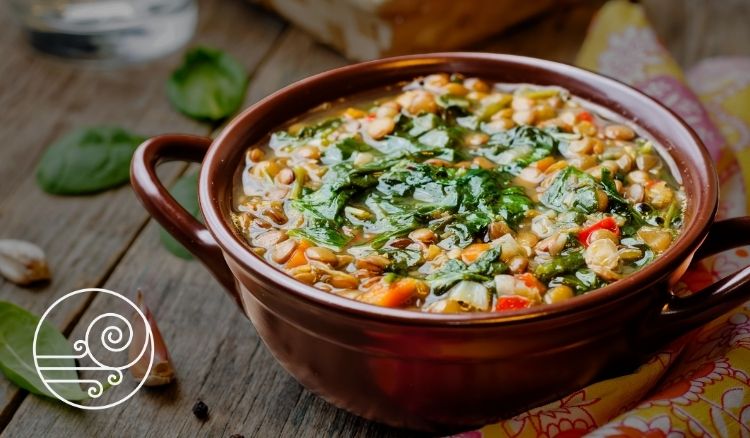
Kitchari, also known as khichdi, is a preparation of white basmati rice and split yellow mung dal, cooked together until soft and soupy and seasoned with gentle digestive spices: cumin, coriander, turmeric, and a small amount of fresh ginger. It has been the cornerstone of Ayurvedic cleansing for thousands of years because of a quality almost no other food possesses: it offers complete protein, complex carbohydrates, and deep nourishment while demanding almost nothing from agni.
During a cleanse, kitchari can be eaten at every meal. By eating the same simple preparation, the digestive system does not need to recalibrate for each new food. It settles into a rhythm of efficient, easy processing while agni turns its attention toward what has accumulated, not just in the channels, but in the tissues that hold what the body never fully processed. What most people discover by the second or third day is that the digestive quiet creates room for something else to move. The heaviness after meals lifts. But so does something older.
Warm Broths
For those who need a gentler entry into cleansing, or whose agni is significantly depleted, warm broths offer an even lighter starting point. Vegetable broth with ginger, or simple mung soup strained to a liquid, provides nourishment without any digestive demand. Spending one or two days on broths before transitioning to kitchari is a classical approach for those whose digestive fire needs the gentlest possible restoration.
Ghee
Ghee (Butyrum clarificatum) is added to kitchari and to broths throughout the cleanse. In classical Ayurveda, ghee supports the integrity of the gut lining, acts as a prebiotic for beneficial microorganisms, carries medicinal properties from spices deeper into the tissues, and has a gentle cooling quality that soothes the inflammation associated with pitta excess. A small amount of high-quality ghee at each meal is part of the medicine, not an addition to it.
Additional Supportive Foods
Beyond kitchari and broths, the following can be incorporated for variety:
- Cooked vegetables such as zucchini, sweet potato, beets, and leafy greens
- Fresh ginger tea with raw honey, taken away from meals
- Coconut water for hydration, especially for pitta cleanses or pitta types
-
Basmati rice congee for extra digestive gentleness
For those with signs of pitta excess, cooling herbs such as coriander and fennel specifically support the liver, where agni's cleansing action is most concentrated.
Foods to Avoid During an Ayurvedic Cleanse
During an Ayurvedic cleanse, foods that are heavy, cold, processed, or difficult to digest are set aside to reduce the burden on agni and allow accumulated ama to be processed rather than added to. Every food avoided during a cleanse is a request being honored: the digestive system asking for space to complete the work it has been putting off.
Avoid during a cleanse:
- Raw and cold foods, including salads, cold drinks, and refrigerated items
- Dairy products other than ghee, particularly hard cheeses and yogurt
- Gluten-containing grains, which are complex and taxing to digest
- Meat, fish, and eggs, which require significant digestive resources
- Processed foods, refined sugar, and packaged snacks
-
Alcohol and caffeine, which both tax the liver and disturb agni's rhythm
Setting these foods aside is not a deprivation. It is a choice made from a different kind of knowing: the recognition that the body has been carrying more than food for a long time, and that for a few days, it deserves to carry less. The body responds to that recognition. Sometimes quickly, and with a kind of relief that surprises.
Lifestyle Practices to Support the Cleanse
An Ayurvedic cleanse is not limited to diet. Sleep, movement, timing, and daily self-care practices collectively determine whether agni can recalibrate or whether other demands continue to tax it. In Ayurveda, the container created around a cleanse is as much a part of the medicine as the food itself.
Dr. Lad's lineage teaches that the timing of meals is among the most powerful interventions available during a cleanse. The largest meal eaten at midday, when agni reaches its natural peak, works with the body's own intelligence rather than against it: feeding the flame when it is strongest and allowing it to rest when it naturally dims.
Supportive practices during a cleanse:
- Tongue scraping each morning: use a copper or stainless steel scraper to remove the coating that accumulates overnight, the visible evidence of ama moving through the system
- Warm oil self-massage (abhyanga): applying warm sesame oil to the body before bathing moves lymphatic fluid, supports detoxification through the skin, and grounds vata, which tends to become unsettled during a cleanse
- Dry brushing (garshana): a traditional practice using raw silk or natural fiber gloves to stimulate lymphatic drainage and clear the channels beneath the skin
- Eating the largest meal at midday: when agni is at its natural peak and most capable of complete digestion
- Early sleep before 10pm: honoring the pitta cleansing window of 10pm to 2am when the liver performs its deepest nightly clearing
-
Gentle movement only: walking, yin yoga, and slow stretching; vigorous exercise depletes the same resources the cleanse is trying to restore
Reducing stimulation during a cleanse is as important as the dietary changes. Quieter, simpler days are not an indulgence. They are part of the protocol.
When an Ayurvedic Cleanse Is More Than a Diet
While a basic Ayurvedic cleanse diet is appropriate for most healthy adults, constitutional differences significantly affect how the body responds to simplification and cooling. What restores one person's agni may deplete another's, making constitutional awareness the first essential step in personalizing any cleanse protocol.
Those with a vata-dominant constitution or significant vata imbalance, characterized by irregular digestion, low body weight, anxiety, or dryness, may find that even a simplified diet is too light without additional grounding. Warm sesame oil massage, extra ghee, and root vegetables added to kitchari can help anchor the cleanse for vata types.
Those with a kapha constitution, characterized by sluggish digestion and tendency toward heaviness, may need warming spices added to kitchari, ginger tea throughout the day, and gentle movement to prevent the cleanse from deepening stagnation.
A pitta cleanse, designed specifically for excess fire, uses the same foundational foods with additional cooling modifications and is the framework this article is primarily built around.
Some signs that indicate a need for personalized guidance before beginning:
- Pregnancy or nursing
- Active chronic illness or recent surgery
- Significant underweight or history of disordered eating
-
Prescription medications, particularly blood thinners or immunosuppressants
This content is educational and does not replace personalized medical or Ayurvedic guidance. Please consult a qualified practitioner before beginning any cleanse protocol.

Why Simplicity Is the Medicine
The central teaching of an Ayurvedic cleanse is that the body already knows how to restore itself. The cleanse creates the conditions for that restoration: simplicity, warmth, rest, and reduced demand. What returns when agni is given genuine rest goes beyond better digestion. The clarity rises from beneath the accumulation. Emotion moves through cleanly. Sleep settles deeper. The low-grade noise the body was generating to manage what it could not process finally quiets.
What the ancient texts placed at the center of all healing, and what every well-supported cleanse continues to confirm, is that agni is the ground of all transformation. When it is restored, the body does not simply function better. It metabolizes experience as well as food. Difficulty becomes wisdom. Challenge becomes growth. Emotion moves through without accumulating as resentment or reactivity.
When the digestive fire is given genuine rest, what the body builds from that simplicity is ojas: the subtlest essence of perfect digestion, the quality that expresses itself as clarity, deep immunity, and the felt sense of being fully alive.
Simplicity, in Ayurveda, is a form of medicine unlike any other: the condition in which the body's own intelligence finally has room to work. The body does not ask for much. A bowl of warm rice. A quiet afternoon. Room enough for the fire to find its own way back.
This guide is where that understanding begins. The Pitta Cleanse is where it becomes a held practice.
The AyurPrana Home Cleanse is a guided 21-day practice developed under the lineage of Dr. Vasant Lad, BAM&S, MASc, founder and director of The Ayurvedic Institute. For those ready to move from understanding to practice, the Home Cleanse offers what a guide cannot: the structure, the lineage, and the community of doing it together.
[Explore the AyurPrana Home Cleanse]
Frequently Asked Questions
How often should you do an Ayurvedic cleanse diet?
Ayurveda recommends cleansing at seasonal transitions, making three to four times per year the natural rhythm for most people. A weekend of simplified eating once a month maintains the terrain between deeper seasonal cleanses. For those with significant ama accumulation or active pitta imbalance, a more structured cleanse of seven to twenty-one days under qualified guidance may be appropriate once or twice annually.
Can I lose weight with an Ayurvedic cleanse?
Weight loss may occur during an Ayurvedic cleanse as ama and excess water are released, but it is not the primary goal. The cleanse targets restoration of agni and clearing of metabolic waste. When agni returns to balance, the body's natural weight tends to stabilize. Sustainable weight regulation in Ayurveda is a consequence of restored digestive intelligence, not the objective of cleansing.
What herbs are best for an Ayurvedic cleanse?
Triphala, a classical formulation of Terminalia chebula, Terminalia bellerica, and Phyllanthus emblica, is the most widely used Ayurvedic cleansing herb, supporting gentle elimination and digestive clearing. Amalaki (Emblica officinalis) cools and rejuvenates. Ginger (Zingiber officinale) kindles agni and supports ama clearance. Fennel (Foeniculum vulgare) eases bloating and excess heat. Always consult a qualified practitioner before beginning an herbal protocol.
How long does a typical Ayurvedic cleanse last?
A simple home Ayurvedic reset typically runs three to seven days, long enough for agni to recalibrate and ama to begin moving. A 7-day cleanse is a common entry point for beginners. Deeper protocols, such as the 21-day guided process or a guided panchakarma-based programs, extend to twenty-one days or more, including classical practices like oleation and purgation under clinical guidance. Duration is determined by constitution and the degree of imbalance.
Is kitchari mandatory in every Ayurvedic detox?
Kitchari, also spelled khichdi, is the most recommended food during an Ayurvedic cleanse because of its unique combination of complete nourishment and minimal digestive demand. Warm broths, rice congee, and cooked vegetable soups can substitute, particularly for those who need a gentler entry. The principle is easy digestibility and warmth, not the specific dish. Kitchari simply fulfills that principle most completely.